Context — a system under a growing load.
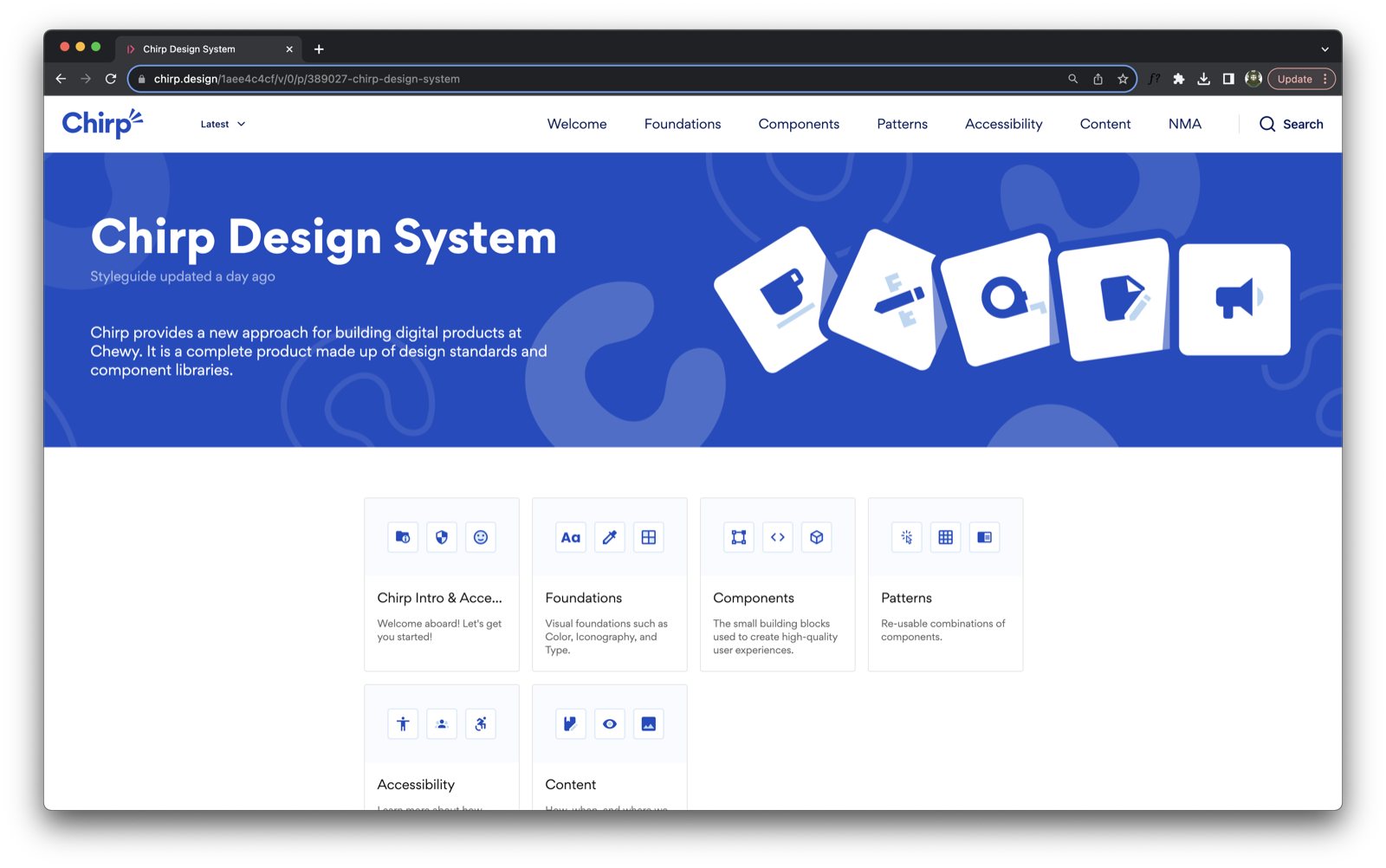
Chirp was Chewy's design system, and during my tenure the product organization was scaling fast. The libraries were strong and the components were good, but the scaffolding around them — documentation rhythms, contribution norms, release communication — hadn't kept up with hiring. Chirp needed to support four distinct Chewy brand themes, Chewy's first international launch (Canada), and a platform whose reach extended to over 20 million monthly active users. The next phase of the system wouldn't be about more components — it would be about operational muscle.
Approach — design system as a product.
The team's north star was simple: treat the design system as a product inside Chewy. We instilled a culture of respect for Chirp — rituals, procedures, regular check-ins with internal customers, and frequent updates so every feature team understood Chirp's role in brand consistency and delivery speed.
Our work was rooted in tight collaboration with a dedicated team of front-end engineers. Design and code progressed in tandem — not handed across a wall. That shared ownership is why Chirp kept up with the org's growth instead of being rebuilt every time a new team spun up.
Accessibility was built into components, not layered on after. WCAG contrast, keyboard navigation, and screen reader compatibility were first-class requirements during the build — not review gates at the end.
Design tokens were the pivot that made the approach work. A tokenized foundation for color, typography, and spacing let us theme products iteratively, spin up new brand surfaces without rebuilding components, and carry a first international launch on the same system.
Leading Chirp — my contributions.
Within the team, I took ownership of several threads that kept the system honest at the org's scale:
- Public design feedback. I consistently offered product design feedback in public Chirp channels, promoting collaboration and knowledge sharing across the 70+ designers and 15 feature teams. When a topic needed more voices in the room, I pulled designers into weekly Office Hours.
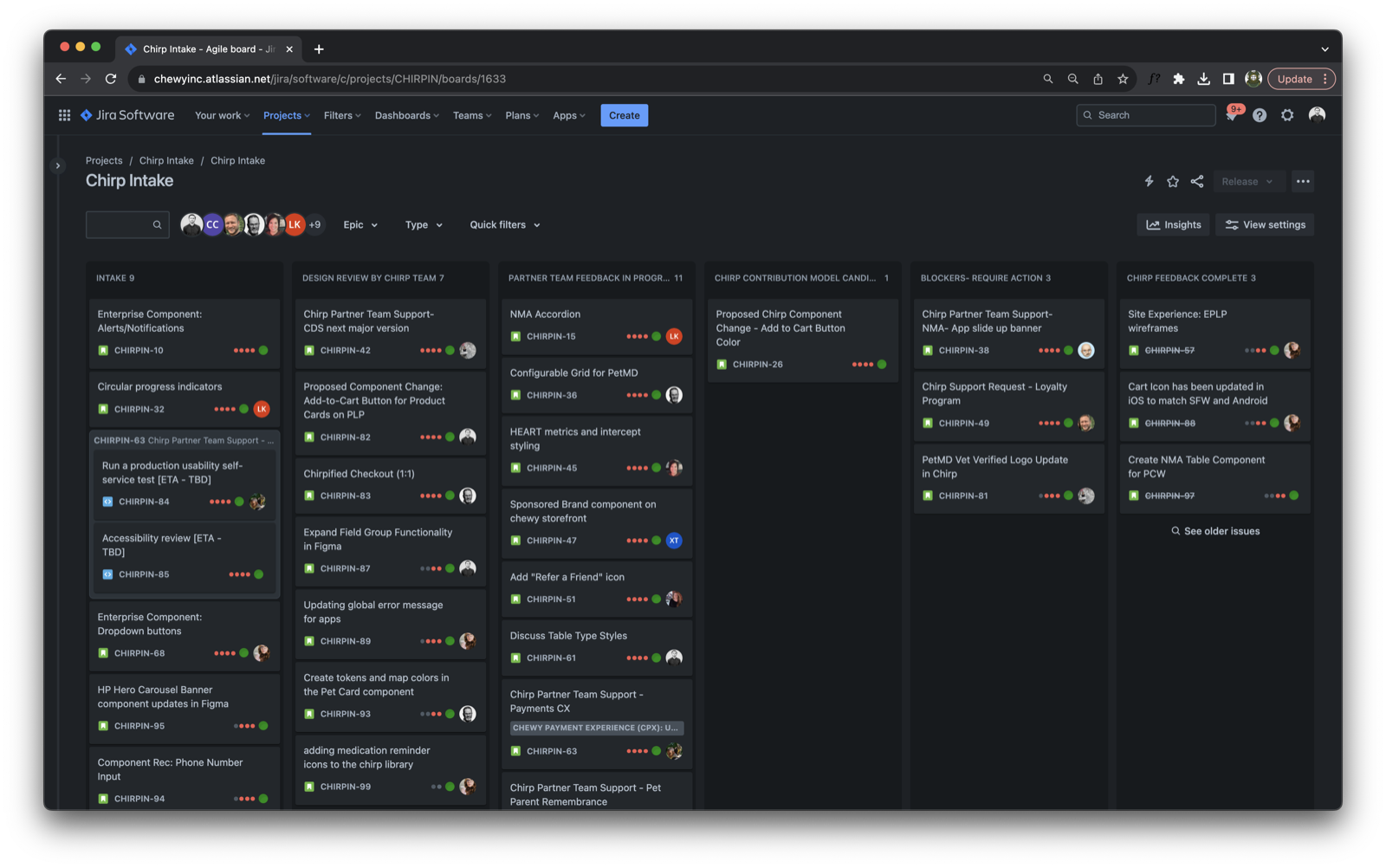
- Intake request management. Prioritized incoming component and pattern requests against organizational goals, and tracked delivery timelines with our engineering counterparts so nothing sat in limbo.
- Documentation ownership. Owned the Chirp documentation site — continuously gathering internal feedback to improve usability and keep it current as the authoritative reference for our internal customers.
- Automated release notes. Stood up a webhook-driven release notes pipeline that posted real-time updates to a public Slack channel whenever Figma components or documentation shipped. Cut design system overhead to near zero and kept the whole product org informed without a human-in-the-loop.
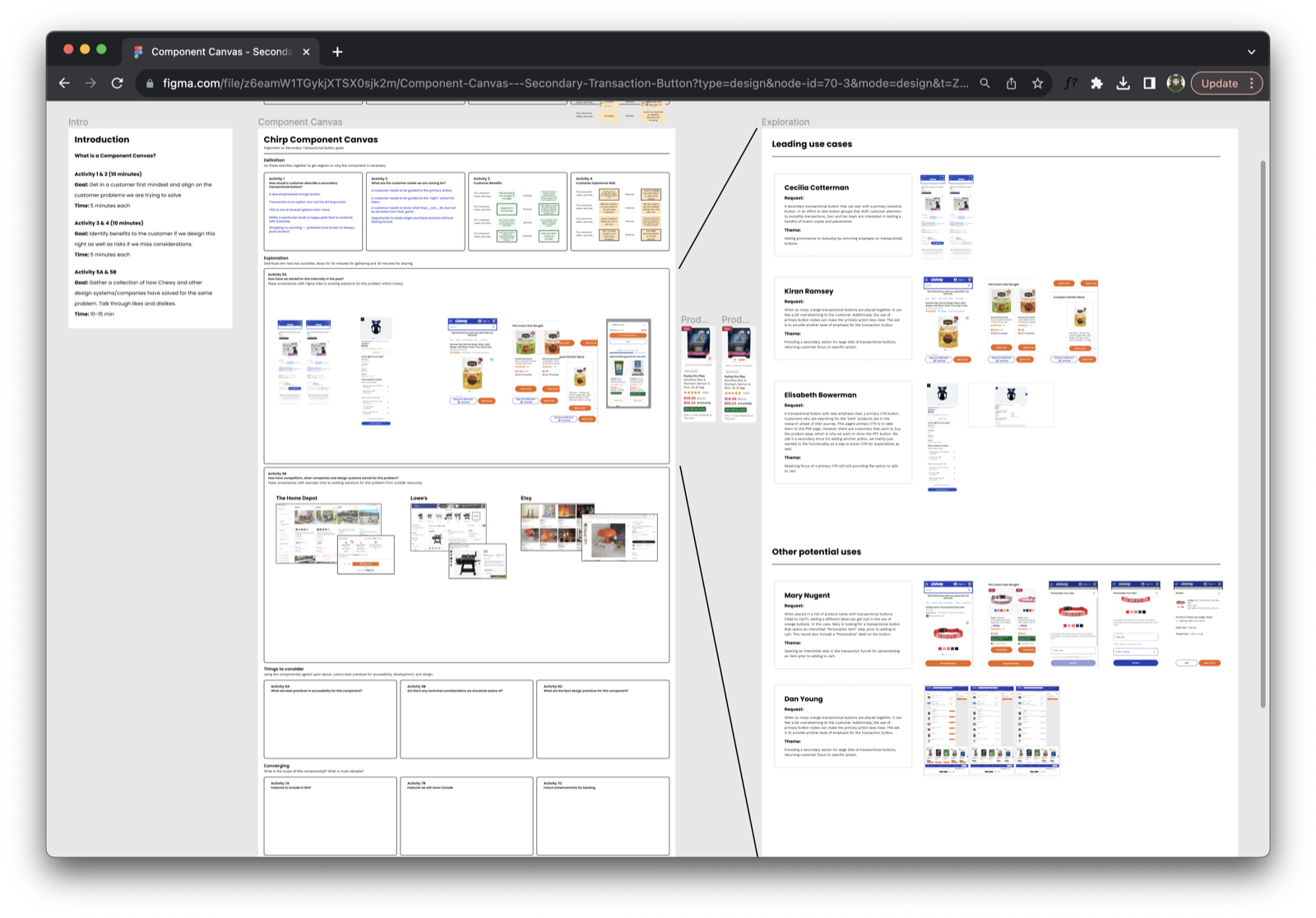
- Component workshops. Facilitated workshops that guided the creation of new components with a minimum of three real use cases — a practice that expanded the library while keeping every addition versatile and justified.
- Project 49. Led product design for Chewy's first internationalization launch — Canada, August 2023 — including provisioning tokenized themes to support new locales and languages.
- Accessibility partnership. Partnered with the Director of Accessibility to raise the bar on inclusive components, with particular focus on non-sighted users, motor-impaired keyboard users, and screen reader customers.
Outcomes.
Over two and a half years, Chirp grew into Chewy's default way of shipping UI — and did so while roughly doubling its reach without expanding headcount. The system anchored a first international launch, four brand themes, and a feature-team footprint that touched the whole customer-facing surface.
Reflections — what endured.
The most durable thing we built at Chewy wasn't a component — it was a set of habits. Documentation that read the same way across every pattern. A share-out cadence that kept Chirp's changes legible to a growing org. Release notes that arrived in Slack the moment something shipped. Contribution norms that let any designer propose a pattern through a known path. A catalog is a snapshot; a practice is what keeps the snapshot current.
The other thing I'd repeat: partnering tightly with the Director of Accessibility early. When accessibility lives in the review stage, it becomes adversarial. When it's a co-authored requirement baked into the build, it becomes a quality signal. Chirp got stronger the day that became default.